
The winners of the annual Wood Awards have been announced. The judges have selected six structures and three products that represent the best of British architecture and product design in wood. Established in 1971, the Wood Awards is the UK’s premier competition for excellence in wood design. The competition is free to enter and aims to encourage and promote outstanding timber design, craftsmanship and installation.
The Wood Awards is one of the few design competitions to go ahead despite COVID-19. The independent panel of judges always visits all the shortlisted projects in person, making this a uniquely rigorous competition. This year, the usual judging process had to be adapted, but the competition persevered, and the judges still managed to see each project.
GOLD AWARD & PRIVATE WINNER
The judges chose The Rye Apartments as this year’s Gold Award and Private category winner. The Gold Award is given to the winner of winners. Judge Jim Greaves comments, “Tikari Works have taken a gamble and done something very unusual and it’s paid off, the apartments are very popular.”

Location: London
Architect: Tikari Works
Structural engineer: Webb Yates
Wood supplier: Stora Enso
CLT subcontractor: Eurban
3-layer board: Binderholz
Species: Austrian spruce
©JackHobhouse

This development of ten sustainable apartments sits on a prominent corner site. A mix of one, two, and three-bedroom units are set in two blocks that respond independently to the changing scale across the site. The user’s quality of life is at the heart of the design. The project was driven by two key considerations; how to
resist standardised or default positions within housing design, and how to minimise the materials, embodied carbon and cost. CLT was used for the superstructure and all the internal walls and staircases. The CLT is exposed throughout, creating large, lightfilled spaces and a comforting atmosphere. These volumes are detailed with white-washed ash floors. Delicate spruce strips form dropped ceilings in the hallways and bathrooms. Kitchens cabinets are made from CNC grooved three-layer spruce ply boards and the worktops are made from recycled paper. The limited palette of natural materials helps to minimise visual clutter.
COMMERCIAL & LEISURE
The Commercial & Leisure winner is Frindsbury Manor Barn. The judges admired the attention to detail and scale of the conservation project.

Location: Rochester
Architect & client: The Heritage Design & Development Team Ltd
Structural engineer: The Morton Partnership
Main contractor, joinery & wood supplier: Dolmen Conservation Ltd
Species: British oak

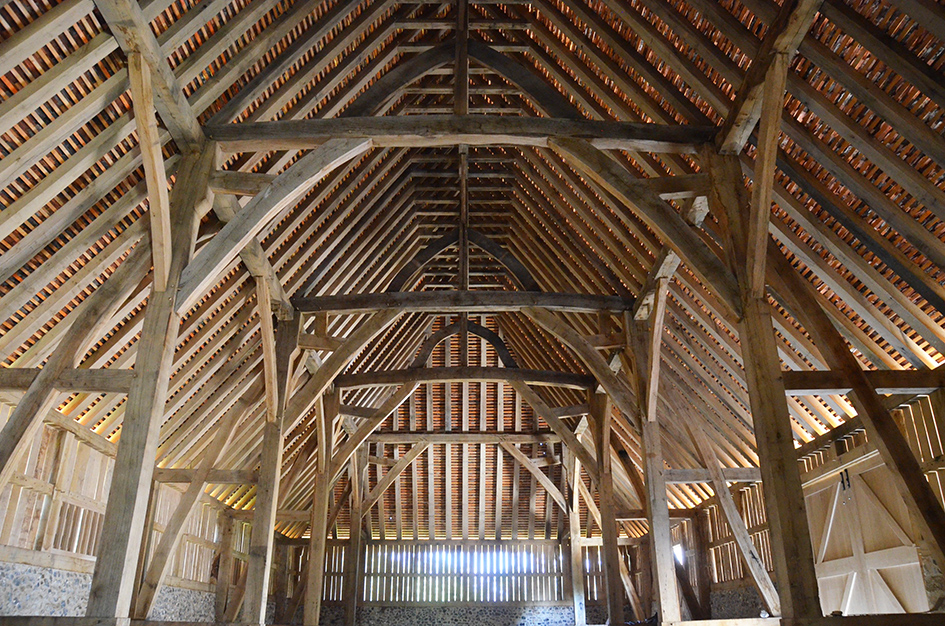
This Grade 1 listed medieval barn, originally built in 1403, was damaged by fire in 2003. At 210 feet long it is the longest barn in the UK. A third of the barn was re-built in locally sourced green oak. Large quantities of curved timber were selected for braces and tie beams. In total, 1400 f3 of oak was used. Extensive stone repairs were also needed. 95,000 Kent peg tiles were used to re-tile the old and new sections of the barn. The project was based on the fundamental principles of conservation: ‘maintain as much of the historic fabric as possible whist ensuring the building has a viable future use’. The barn and its surrounding areas are steeped in history and it remains fundamental to the local community.
EDUCATION & PUBLIC SECTOR
Swimming Pool Hall at King’s College School, Wimbledon was selected as the Education & Public Sector winner. Judge Kirsten Haggart says, “The different timber elements all have the same white-washed tone and coordinate perfectly with the reinforced concrete columns, creating a beautiful place which has an intimacy that most pools lack.”


Architect: David Morley Architects
Client: King’s College Wimbledon
Structural engineer: Price & Myers
Main contractor: Knight Harwood
Timber contractor: B&K Structures
Joinery: Suffolk and Essex Joinery Ltd
Wood supplier: Metsa Group Ltd
Species: spruce, pine, fir, larch (European)
The Swimming Pool Hall is one of three linked pavilions comprising a new sports centre for the school. The building’s design has strong visual connections between indoors and outdoors to encourage physical activity among students whilst seamlessly connecting the old facilities. The form of the roof evokes a dynamic sense of movement in water. From outside, it sweeps down to respect the boundary with a Grade 2* listed building. Internally, it sweeps up to accommodate a viewing
gallery. Curved glulam beams support CLT roof panels with integral timber acoustic linings. The roof’s geometry and pale stained finish reflect natural top-light and artificial uplighters, eliminating the need for any light fittings above the pool. The flush pool edge and glazing on three sides allow views to the outside.
SMALL PROJECT
This year’s Small Project winner is Wooden Roof. The judges were impressed by the light and airy garden room andmwere particularly interested in the process of design through to construction.

Location: London
Architect: Tsuruta Architects
Structural engineer: Webb Yates
Main contractor: JK London Construction
Joinery: Pracownia Wystroju Wnetrz Art Deco -R
Wood supplier: Arnold Laver
Species: Accoya (New Zealand), ash (Canada)

This conservatory, built for an existing Grade 2 listed house, sits in a north-facing garden. The roof profile had to be pitched shallow to ensure that it sits below the existing adjacent boundary wall shared with the neighbour. The roof also needed to be welldrained. One solid piece of wood, enclosed by four seasons
glazing units, forms the entire structure and acts the building’s envelope, structure, insulation and cladding. The diagrid frame is a combination of falls that are either short and steep or long and shallow. The pieces were all CNC fabricated and were light enough to be assembled manually onsite. The beam cross junctions were fixed without any glue or mechanical fixings. Each wood section is wide and deep which helps to emphasise natural light and cast shadows throughout the space.
STRUCTURAL AWARD
This year’s Structural Award winner is the National Automotive Innovation Centre, chosen from all the shortlisted buildings. Structural judge Nathan Wheatley comments, “We are looking for a scheme that has challenged the engineer, where the concept has been delivered in spite of that challenge and where the resultant structure is in some way integral to the success (and architecture) of the building.”


Location: Coventry
Architect: Cullinan Studio
Client: University of Warwick
Structural engineer: ARUP
Main contractor: Balfour Beatty
Joinery: B&K Structures
Quantity surveyor, cost consultant & project manager: Rider Levitt Bucknall
Timber engineer: engenuitiWood supplier: Rubner Holzbau Gmbh, Ober Grafendorf, Binderholz
GmbH
Species: CLT, spruce glulam (European)
©HuftonCrow
The National Automotive Innovation Centre is the largest research and development centre of its kind in Europe. It can hold 1,000 staff and students working across design, engineering and research. Timber was chosen for its warm, natural feel within the industrial setting and its wellness and low carbon properties. The walls were assembled using a pioneering system of prefabricated, self-spanning timber and CLT mega-panels that could be erected quickly. As one of the largest timber roofs in the world, the glulam CLT lattice structure unifies the many activities housed beneath a single umbrella. Primary and secondary joists are arranged on a diagrid, spanning onto supporting beams on a 15m grid. Each bay is slightly pitched above to create a nominal fall for the roof, tapered internally within each bay. The
undulating soffit profile draws users through the space.
JUDGES
The buildings judging panel is led by three-time Gold Award winner Stephen Corbett of Green Oak Carpentry. The panel includes Andrew Lawrence, Arup; Kirsten Haggart, Waugh Thistleton Architects; Nathan Wheatley, engenuiti; David Morley, David Morley Architects; Jim Greaves, Hopkins; and architectural journalist Ruth Slavid. The furniture and product panel is led by design critic, curator and journalist Corinne Julius. The panel includes Oliver Stratford, editor of Disegno magazine; Rod Wales of Wales & Wales; and previous winners Yael Mer of Raw-Edges, Eleanor Lakelin and Sebastian Cox.
SPONSORS
As a not-for-profit competition, the Wood Awards can only happen with collaborative industry sponsorship. Major Sponsors are American Hardwood Export Council and Carpenters’ Company. Other Sponsors include American Softwoods, Timber Trade Federation and TRADA.